

1. GraphRAG Codebase Context
Blame never reviews files in isolation. When analyzing changes, it maps relationships across your entire codebase using Tree-sitter AST queries and a multi-tier PostgreSQL dependency graph.- Impact Analysis: Traces upstream imports and downstream callers across files to evaluate how signature or logic changes ripple through your system.
- Contract & Validation Verification: Detects when modified endpoints or services fail to invoke standard permission guards, schema validators, or audit events used across sibling modules.
- Syntactic AST Chunking: Parses code by functional boundaries (functions, methods, classes, types) rather than arbitrary line counts.
2. Automated PR Reviews & Calibrated Confidence
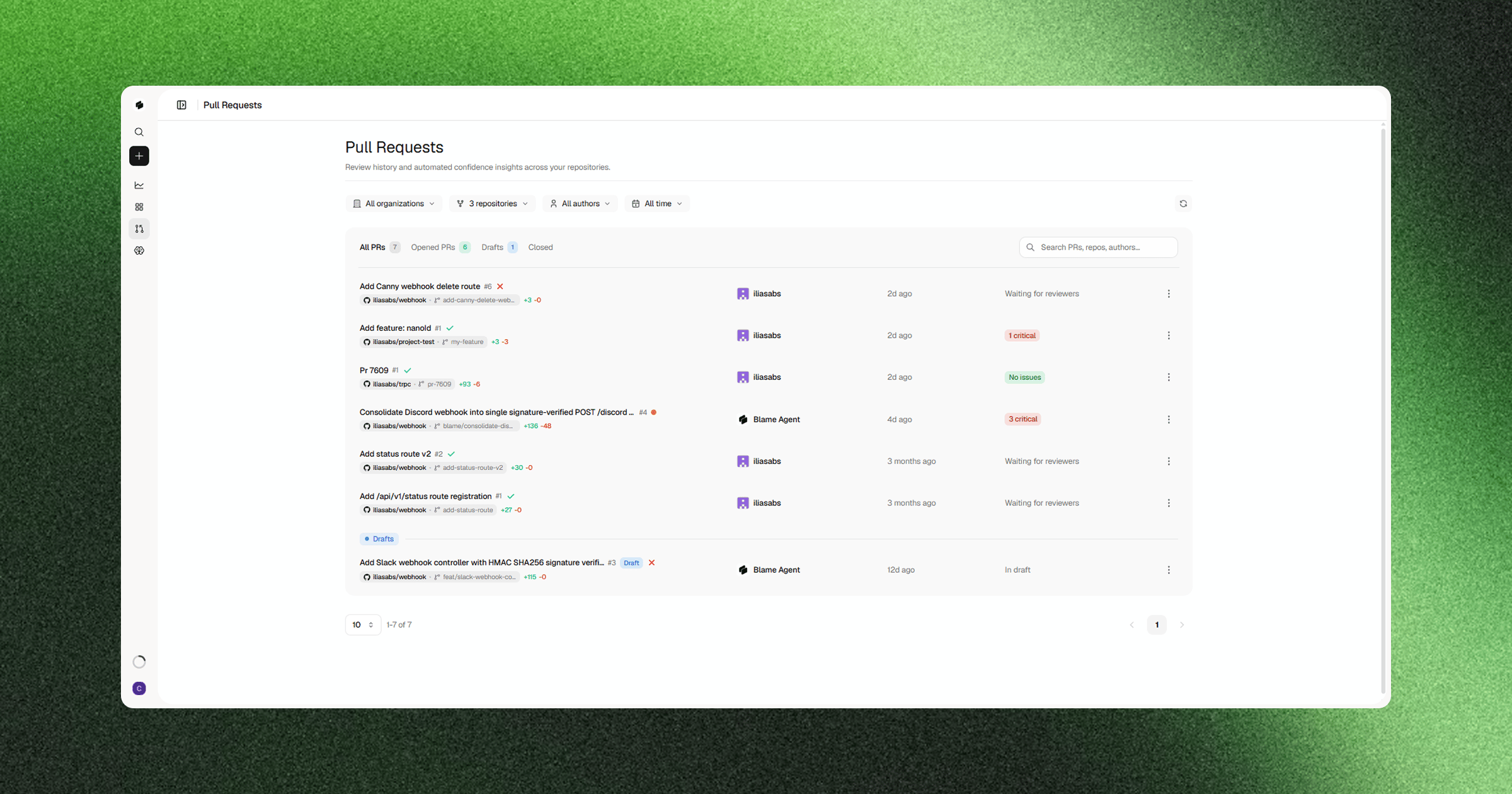
Blame reviews GitHub pull requests automatically upon creation or commit synchronization, providing thorough assessments without rubber-stamping.- Calibrated Score (1 to 5): Every PR receives an overall score (from
5/5 Production Readydown to1/5 Critical Failures) with an explicit technical justification detailing edge cases, test gaps, and stability risks. - 1-Click GitHub Suggestions: Inline comments provide exact, indented replacement code blocks that can be committed directly from the GitHub conversation tab.
- Modular PR Summaries: Configure which sections appear in the PR summary comment, including executive overviews, architectural evaluations, issue tables, sequence diagrams, and comments outside the active diff.
3. Review Strictness & Customization
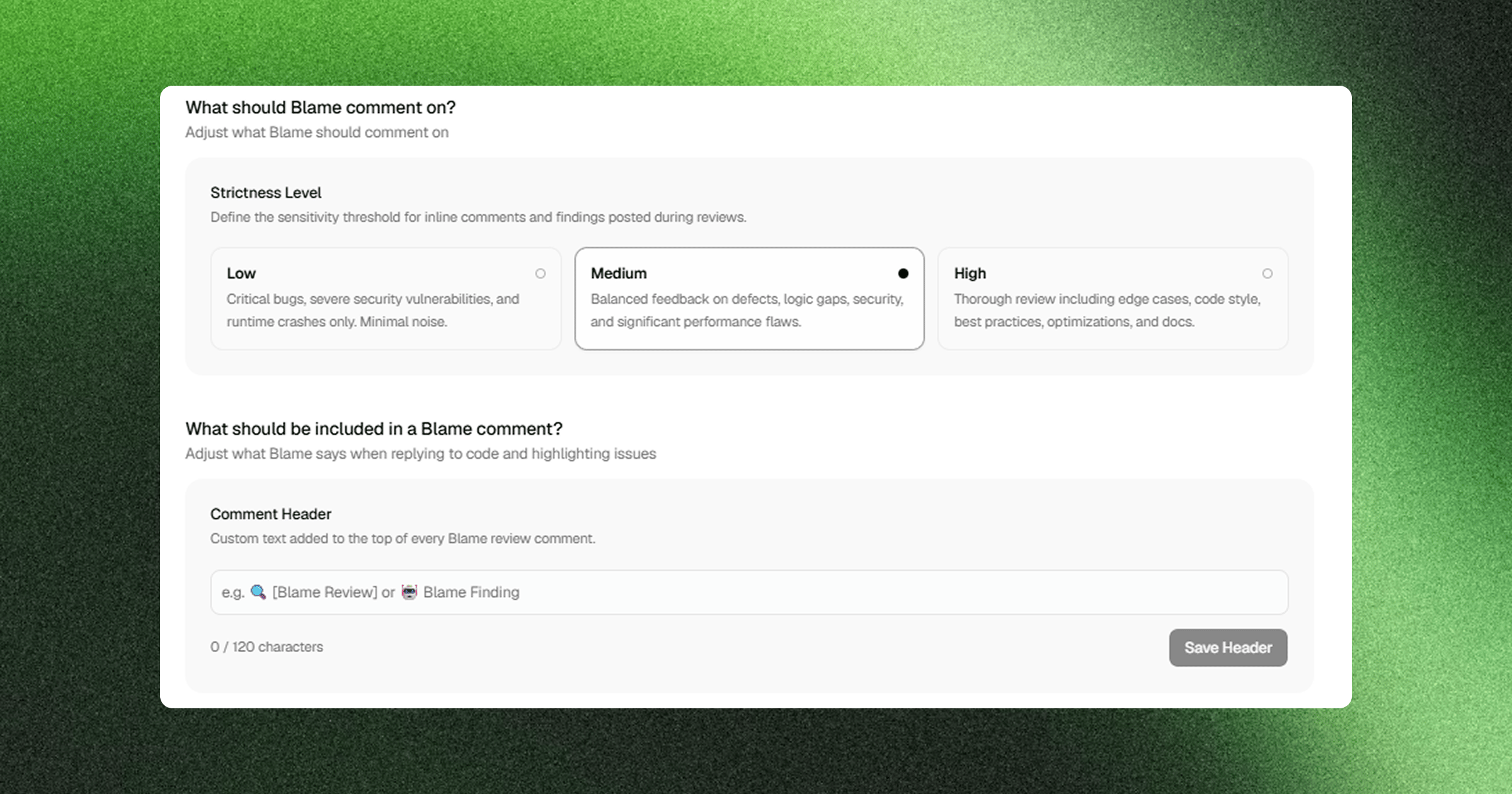
Teams maintain full control over the depth and tone of Blame’s code reviews through workspace and repository settings.- Strictness Levels:
Low: Focuses strictly on critical runtime failures, security vulnerabilities, and crash-inducing bugs.Medium(Default): Evaluates edge cases, missing guards, and architectural consistency.High: Exhaustive review covering performance trade-offs, defensive patterns, and missing test coverage.
- Custom Comment Header: Prepend custom messages or badges to review comments.
- Draft PR Controls: Choose whether to run reviews automatically on draft pull requests or wait until they are marked ready for review.
4. CI/CD Quality Gates & Status Checks
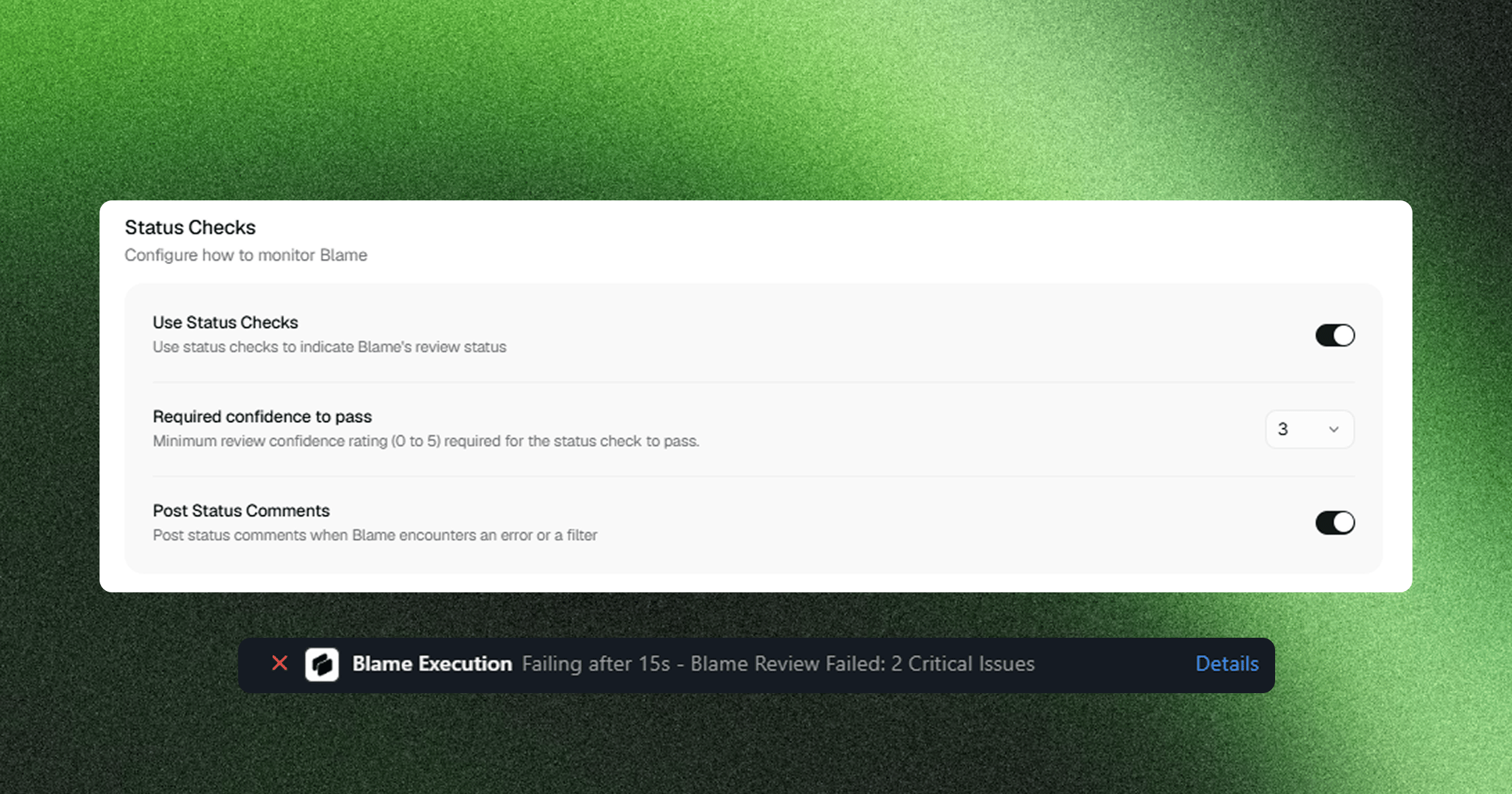
Prevent unstable or risky code from entering your primary branches by integrating Blame into GitHub branch protection rules.- GitHub Check Runs: Automatically creates check runs on GitHub commits reflecting the review outcome.
- Required Confidence Threshold: Enforce minimum confidence scores (e.g. require at least
3/5or4/5) before the check passes. - Automated PR Status Comments: Post pass/fail review status summaries directly to PR discussion threads.
5. Auto-Approve Low-Risk Pull Requests
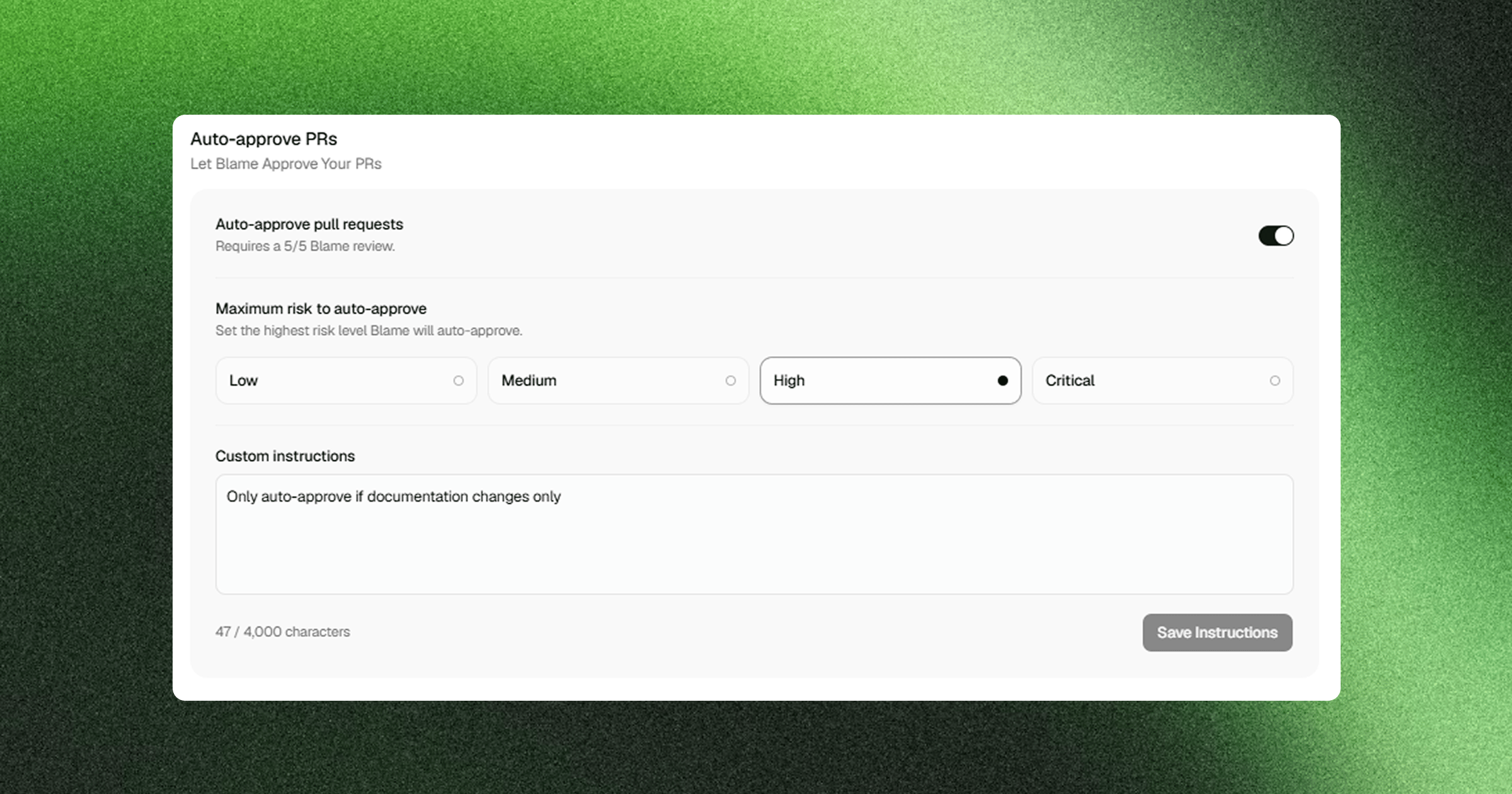
Accelerate routine workflows by allowing Blame to automatically approve low-risk pull requests.- Risk-Capped Approvals: Set maximum allowable risk thresholds (
Low,Medium,High,Critical) for auto-approvals. - Custom Approval Guidelines: Provide specific natural-language rules defining what qualifies for automated approval (e.g., dependency version bumps, documentation updates, or minor UI tweaks).
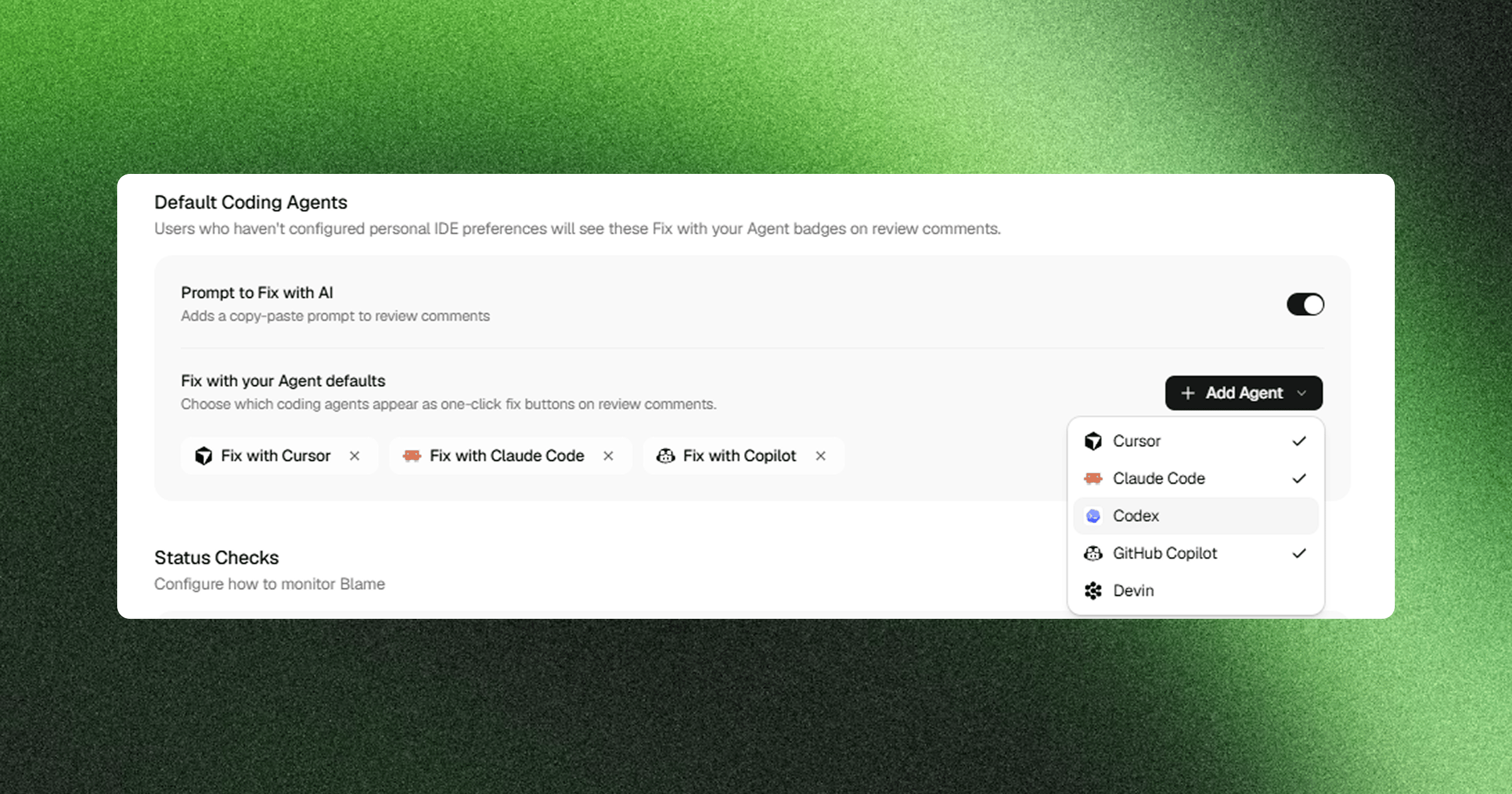
6. Fix with AI Coding Agents
Bridge the gap between review feedback and bug remediation by dispatching Blame’s findings directly to your development environment.- Agent-Ready Fix Prompts: Every inline review comment includes an
agentPromptwith file coordinates, line numbers, and concise fix instructions. - Integrated Agent Support: Format findings for tools like Cursor, Windsurf, Claude Code, Conductor, and Devin.
- Direct GitHub Branch Fixes: Use Blame’s web chat agent to create branches and commit suggested changes directly back to your repository.
7. Repository Memory & Auto-Discovered Rules
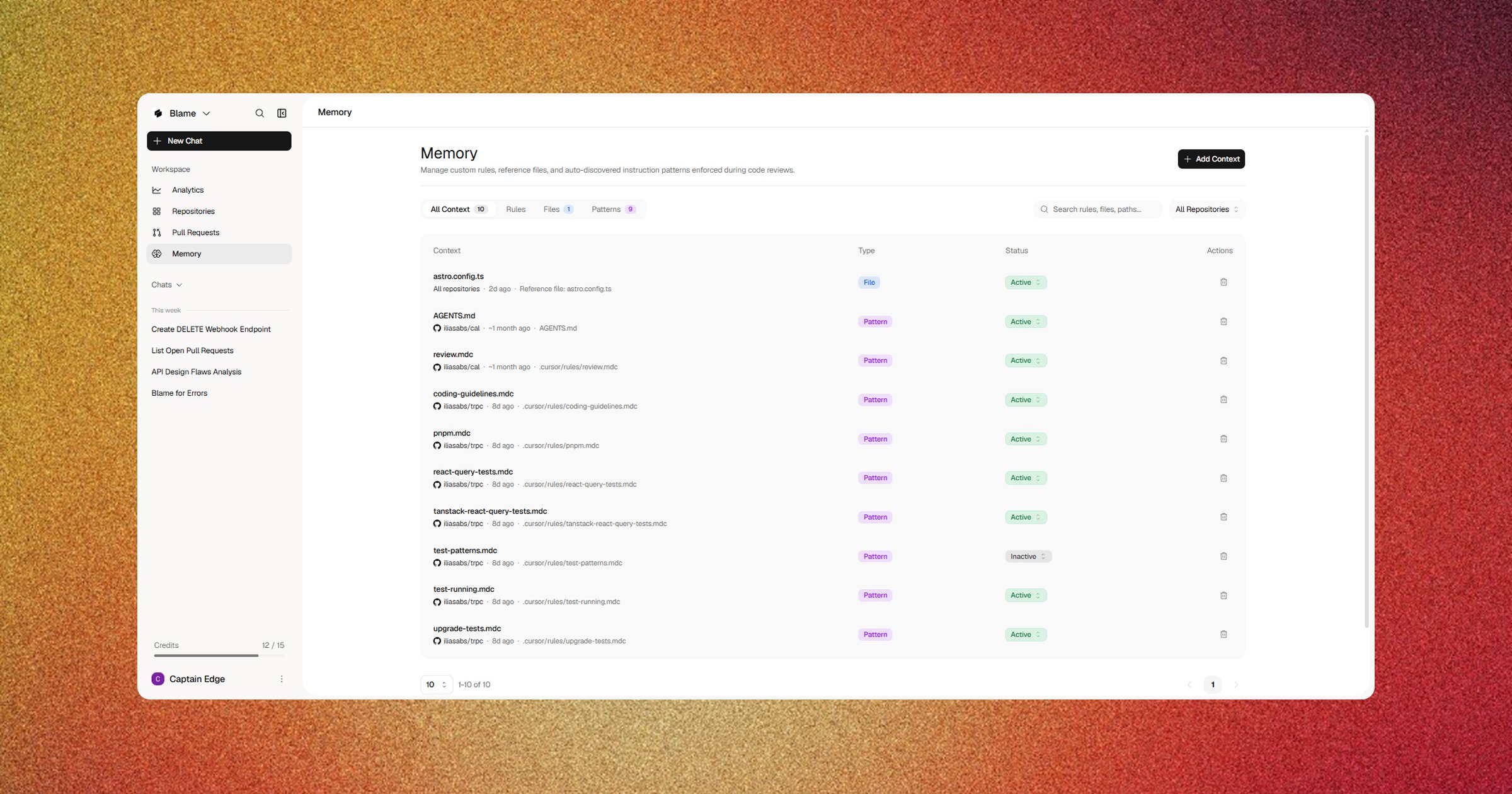
Blame adapts to your team’s conventions without requiring manual configuration.- Zero-Config Rule Discovery: Automatically scans and respects
.cursorrules,.cursor/rules/*.mdc,CLAUDE.md,AGENTS.md,.coderabbit.yaml,blame.yaml, and.github/copilot-instructions.md. - Dashboard Memory Store: Store custom team rules with glob path targeting (e.g.,
services/auth/**) that apply to both automated reviews and chat sessions.
8. Multi-Repository AI Chat
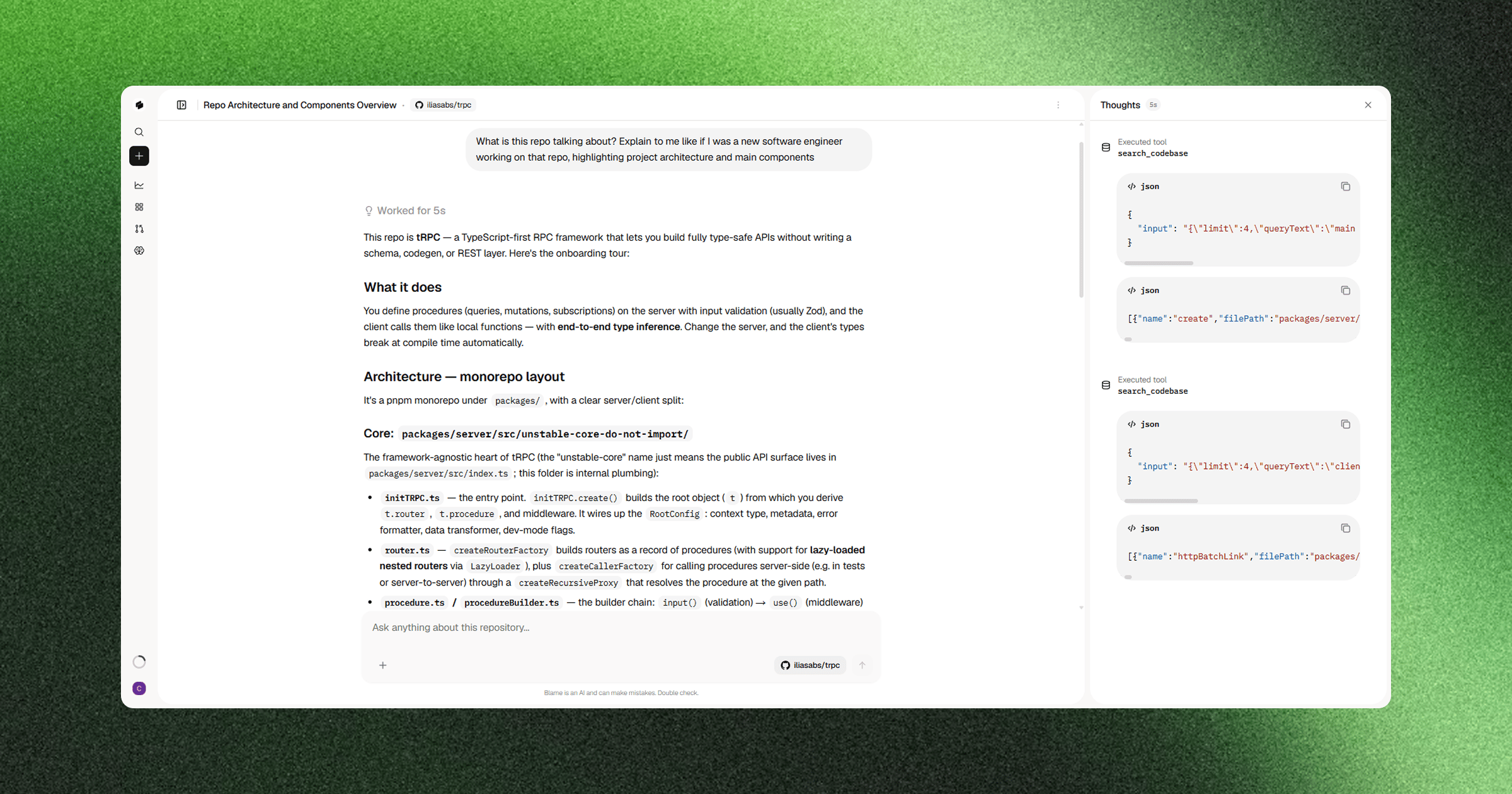
Inspect and debug complex systems spanning multiple codebases in a single conversational thread.- Cross-Repository Scope: Select multiple repositories simultaneously to trace API contracts between frontends, backend services, and shared libraries.
- Voyage AI Reranking: Uses
voyage-code-4embeddings andrerank-3cross-encoders to supply exact AST chunks into the conversation. - Direct GitHub Tooling: List PRs, inspect commit diffs, create branches, and commit fixes directly from chat.
9. Team Workspaces & Notification Hub
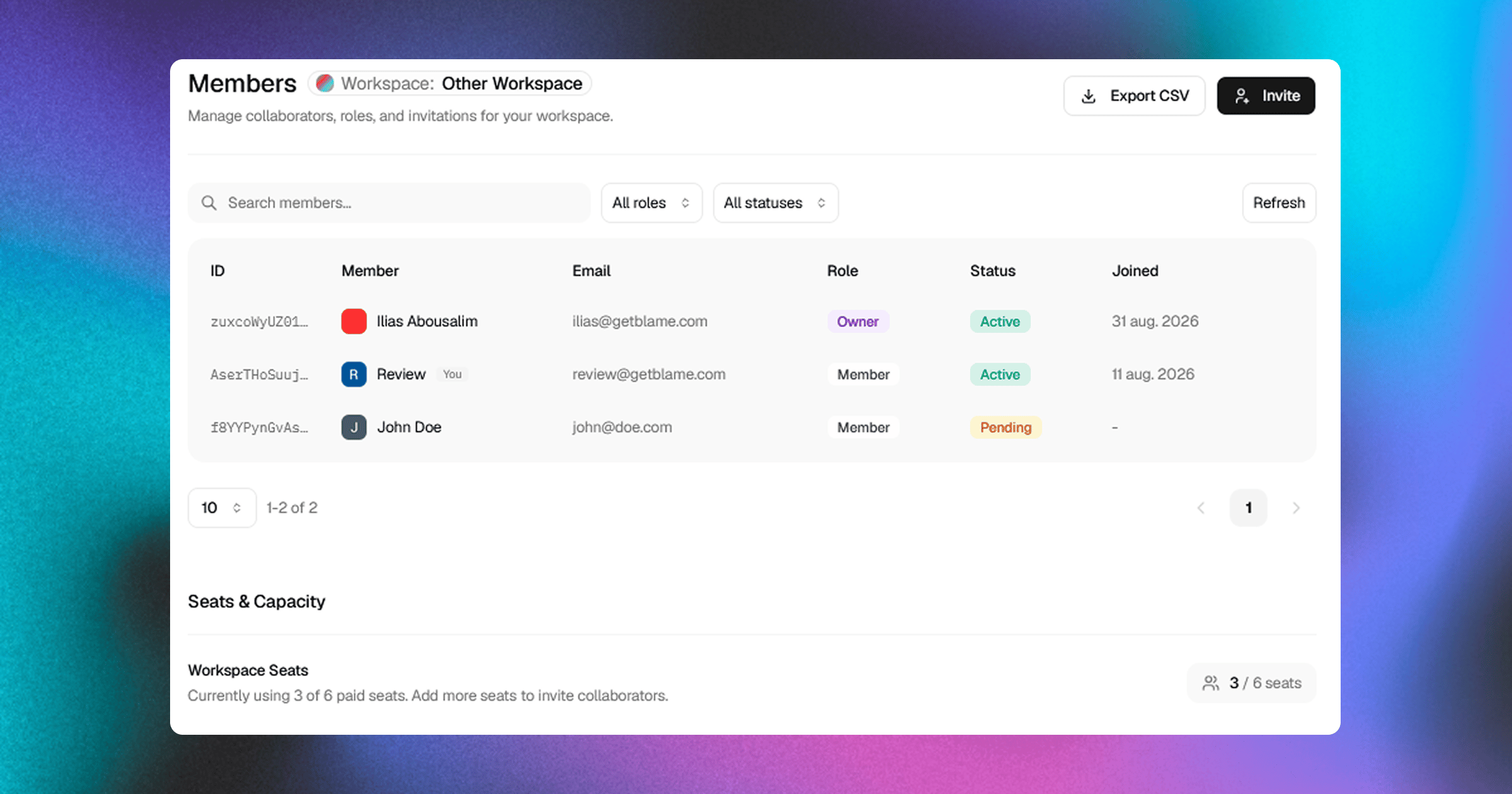
Collaborate smoothly with built-in team governance and external alerting.- Role-Based Access Control: Manage permissions with
Owner,Admin, andMemberroles. - Slack, Linear & Discord Integrations: Receive review notifications, low-confidence alerts, and link PRs directly to Linear issue trackers.
- Seat & Quota Management: Scale seats dynamically with transparent usage tracking.
Next Steps
- Graph-Based Codebase Context — Explore how Blame indexes and queries your codebase.
- Automated Pull Request Reviews — Deep dive into the PR review engine.
- AI Chat & Codebase Memory — Interactive multi-repo exploration workflows.