

How Auto-Approve Works
When a pull request is created or updated, Blame runs its full GraphRAG evaluation pipeline. If the pull request meets all the following conditions, Blame automatically submits anAPPROVE review via the GitHub App:
- Flawless Review Rating: The review achieves a
5/5 Confidence Score(Production ready) with zero critical or high-severity findings. - Within Maximum Risk Cap: The assessed risk profile of the changes does not exceed your configured risk threshold.
- Satisfies Approval Guidelines: The diff complies with your team’s natural-language auto-approval instructions.
Configuring Auto-Approve in Blame
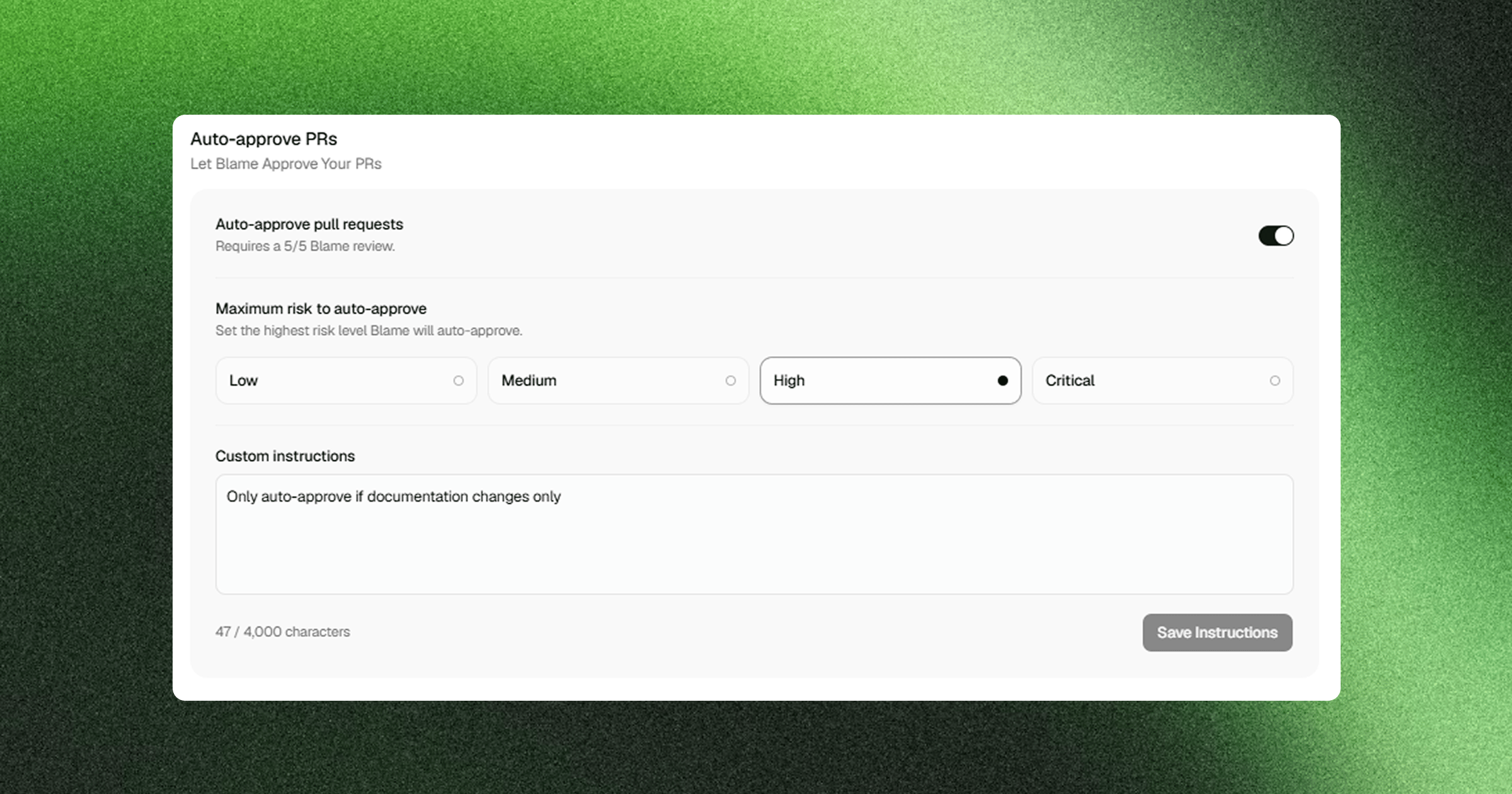
Auto-approve settings can be configured per repository or organization-wide in Settings > Code Review:1. Enable Auto-Approve (auto_approve_prs)
- Enabled: Blame evaluates eligible PRs for automatic approval.
- Disabled (Default): Blame only posts informational reviews and check runs without issuing approvals.
2. Maximum Risk Level (auto_approve_max_risk)
Set the ceiling for what level of risk Blame is permitted to approve automatically:
Custom Approval Instructions
To ensure Blame approves only specific categories of pull requests, you can define natural-language rules in the Custom instructions field (up to 4,000 characters).Recommended Instruction Templates
Scenario A: Documentation & Test Additions Only
Scenario B: Dependency & Automated Bot Updates
Scenario C: Isolated Frontend Styling & Content
Safety Controls & Guardrails
To protect against unintended approvals:- Draft PR Exclusions: Auto-approve evaluates pull requests only when they are marked Ready for review (unless draft reviews are explicitly enabled).
- Branch Protection Compliance: When combined with GitHub Status Checks, a PR will still require all required CI workflows and status checks to pass before merging.
- Immediate Invalidation on New Commits: If a developer pushes new commits to an approved PR, Blame re-evaluates the entire diff and invalidates the previous approval if new issues or risks are introduced.
Related Documentation
- CI/CD Quality Gates & Status Checks — Enforcing status check rules on pull requests.
- Configuring Review Strictness & Customization — Calibrating review depth and comment visibility.
- Review Architecture & Anatomy — Complete anatomy of Blame review comments.