> ## Documentation Index
> Fetch the complete documentation index at: https://docs.getblame.com/llms.txt
> Use this file to discover all available pages before exploring further.
# Review Strictness & Customization
Blame gives engineering teams granular control over automated code reviews. Whether your team wants high-level architectural sanity checks or exhaustive line-by-line verification, you can calibrate strictness, comment styling, section visibility, and review triggers.
To access these settings:
1. Open the Blame dashboard and navigate to **Settings**.
2. Under the **Code Review** section in the left sidebar, select **Strictness**.
 ***
## 1. Review Strictness Levels
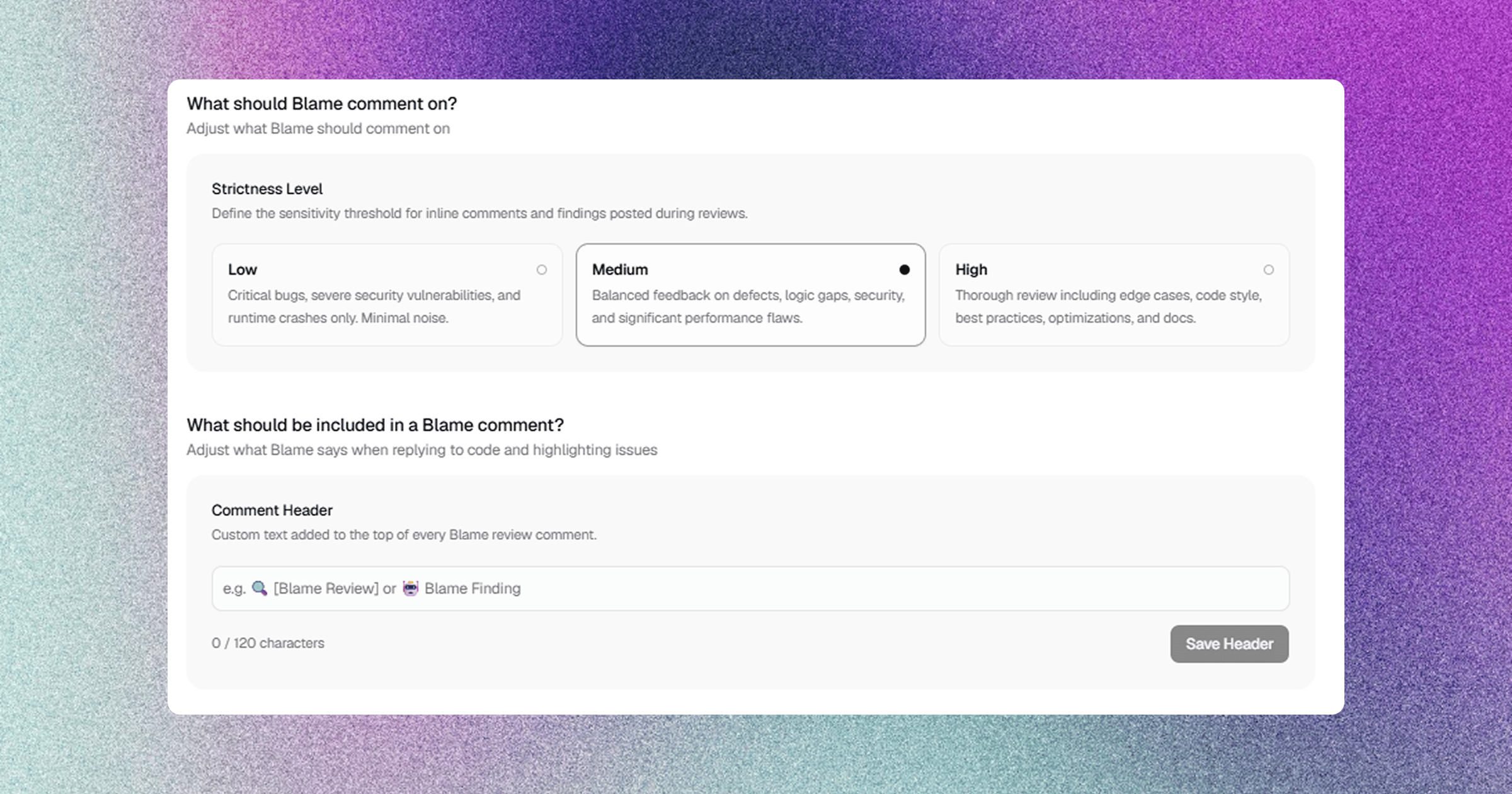
The strictness level determines how aggressively Blame evaluates pull request diffs and what category of findings it surfaces.
| Strictness Level | Focus & Trigger Threshold | When to Use |
| :- | :- | :- |
| `Low` | Flags strictly **critical runtime failures**, **security vulnerabilities**, **broken imports**, and **unhandled fatal exceptions**. | High-velocity teams who only want blockers flagged without styling or non-critical suggestions. |
| `Medium` *(Default)* | Flags critical issues plus **defensive boundary conditions**, **missing schema validation**, **unhandled async errors**, and **architectural consistency**. | Standard production codebases balancing thorough review with developer velocity. |
| `High` | Exhaustive scrutiny covering all the above plus **missing unit/integration tests**, **performance overhead**, **coupling trade-offs**, and **idiomatic optimizations**. | Mission-critical systems, core infrastructure, and compliance-heavy environments. |
***
## 2. Modular PR Summary Sections
Blame allows you to customize the layout of the top-level PR summary comment. Each section can be independently **Enabled/Disabled**, set as **Collapsible (**`
***
## 1. Review Strictness Levels
The strictness level determines how aggressively Blame evaluates pull request diffs and what category of findings it surfaces.
| Strictness Level | Focus & Trigger Threshold | When to Use |
| :- | :- | :- |
| `Low` | Flags strictly **critical runtime failures**, **security vulnerabilities**, **broken imports**, and **unhandled fatal exceptions**. | High-velocity teams who only want blockers flagged without styling or non-critical suggestions. |
| `Medium` *(Default)* | Flags critical issues plus **defensive boundary conditions**, **missing schema validation**, **unhandled async errors**, and **architectural consistency**. | Standard production codebases balancing thorough review with developer velocity. |
| `High` | Exhaustive scrutiny covering all the above plus **missing unit/integration tests**, **performance overhead**, **coupling trade-offs**, and **idiomatic optimizations**. | Mission-critical systems, core infrastructure, and compliance-heavy environments. |
***
## 2. Modular PR Summary Sections
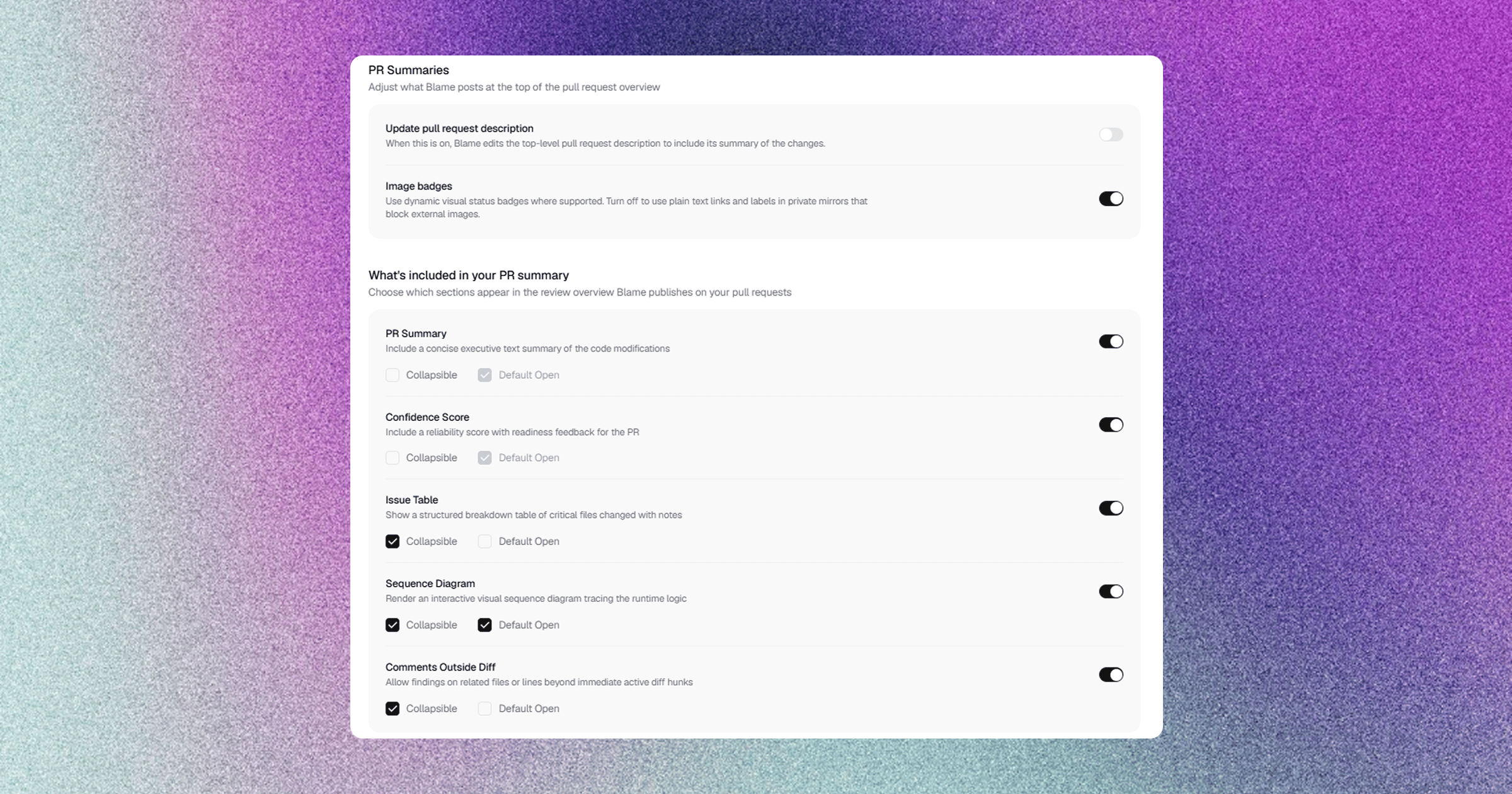
Blame allows you to customize the layout of the top-level PR summary comment. Each section can be independently **Enabled/Disabled**, set as **Collapsible (**``**)**, and configured to be **Default Open** or **Default Closed**.
 | Section Key | Section Name | Description | Default State |
| :- | :- | :- | :- |
| `pr_summary` | **Blame Summary** | Executive overview, architectural design review, edge-case audit, and security analysis. | Enabled (Visible) |
| `confidence_score` | **Confidence Score** | Calibrated rating (`1/5` to `5/5`) with technical justification and merge recommendation. | Enabled (Visible) |
| `issue_table` | **Important Files Changed** | Scannable breakdown of changes and observations per modified file. | Enabled (Collapsible) |
| `sequence_diagram` | **Sequence Diagram** | Auto-generated Mermaid sequence diagram visualizing complex cross-service or async flows. | Enabled (Collapsible) |
| `comments_outside_diff` | **Findings Outside Diff** | Surfaces issues discovered in upstream or surrounding files outside active diff hunks. | Enabled (Collapsible) |
### Summary Customization Options
* **Update PR Description**: Option to append or sync the executive review summary directly into GitHub's initial PR description box.
* **Image & Confidence Badges**: Toggle rendered visual status badges for confidence scores in PR comments.
***
## 3. Custom Review Comment Header
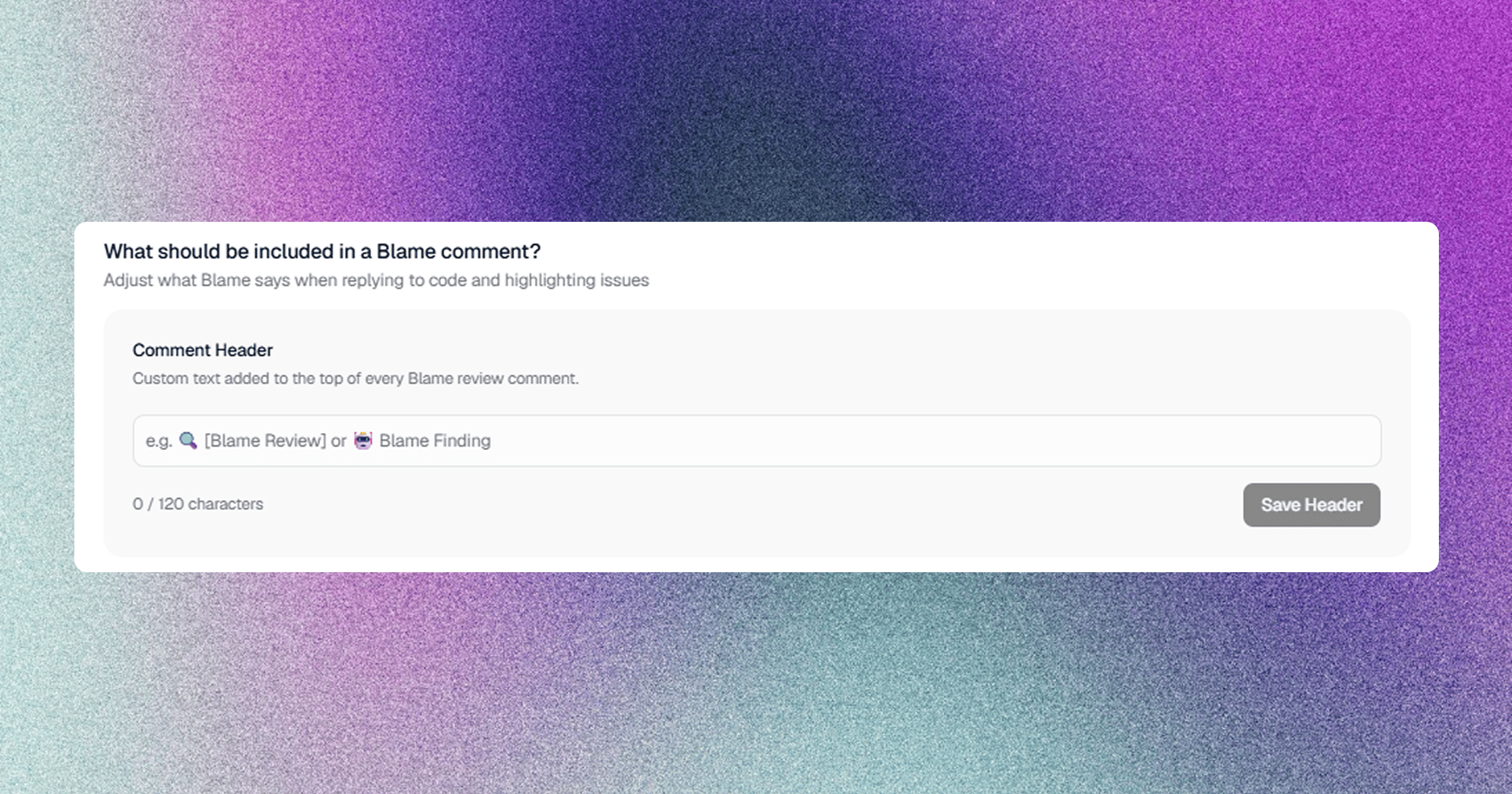
You can configure a custom header (up to 120 characters) prepended to the top of all review summaries and inline comments.
| Section Key | Section Name | Description | Default State |
| :- | :- | :- | :- |
| `pr_summary` | **Blame Summary** | Executive overview, architectural design review, edge-case audit, and security analysis. | Enabled (Visible) |
| `confidence_score` | **Confidence Score** | Calibrated rating (`1/5` to `5/5`) with technical justification and merge recommendation. | Enabled (Visible) |
| `issue_table` | **Important Files Changed** | Scannable breakdown of changes and observations per modified file. | Enabled (Collapsible) |
| `sequence_diagram` | **Sequence Diagram** | Auto-generated Mermaid sequence diagram visualizing complex cross-service or async flows. | Enabled (Collapsible) |
| `comments_outside_diff` | **Findings Outside Diff** | Surfaces issues discovered in upstream or surrounding files outside active diff hunks. | Enabled (Collapsible) |
### Summary Customization Options
* **Update PR Description**: Option to append or sync the executive review summary directly into GitHub's initial PR description box.
* **Image & Confidence Badges**: Toggle rendered visual status badges for confidence scores in PR comments.
***
## 3. Custom Review Comment Header
You can configure a custom header (up to 120 characters) prepended to the top of all review summaries and inline comments.
 ### Examples
* `🤖 Blame Engineering Gate`
* `🛡️ Security & Architecture Review`
* `⚡ Acme Corp Automated CI Review`
***
## 4. Custom Natural Language Review Instructions
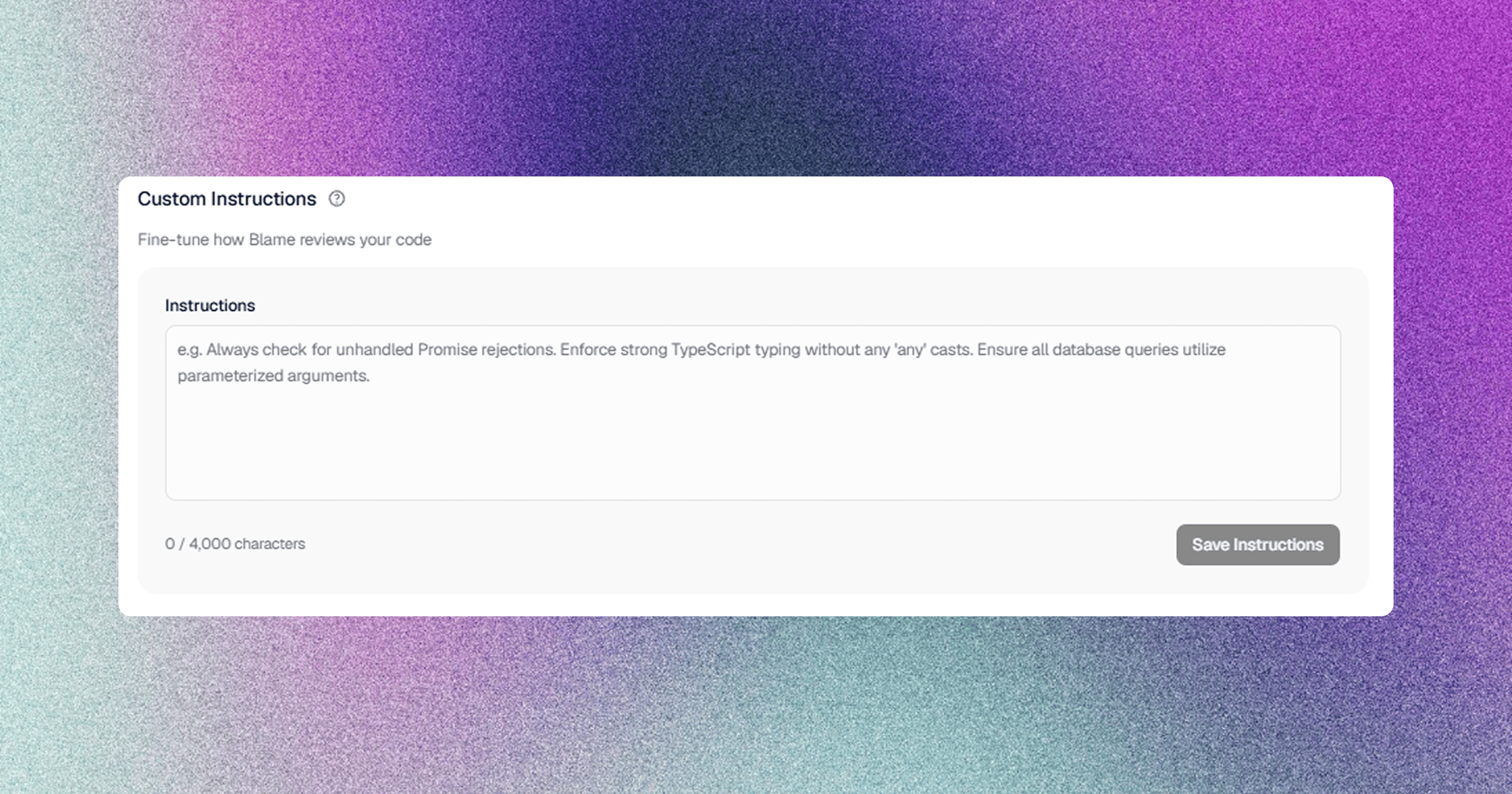
You can provide workspace-level or repository-specific instructions (up to 4,000 characters) to enforce team-specific conventions and guidelines.
### Examples
* `🤖 Blame Engineering Gate`
* `🛡️ Security & Architecture Review`
* `⚡ Acme Corp Automated CI Review`
***
## 4. Custom Natural Language Review Instructions
You can provide workspace-level or repository-specific instructions (up to 4,000 characters) to enforce team-specific conventions and guidelines.
 ### Example Instruction Guidelines
```markdown theme={null}
- We use Zod for all API input validation. Flag any request body that lacks schema parsing.
- Never allow raw SQL strings; all database queries must use our query builder helper (`db.query`).
- Ensure all asynchronous handlers in `app/api/**` return appropriate HTTP status envelopes `{ success: boolean, data?: any, error?: string }`.
- Verify that every new service function includes corresponding unit test files under `tests/unit/`.
```
In addition to custom instructions in the dashboard, Blame automatically discovers and respects `.cursorrules`, `CLAUDE.md`, `AGENTS.md`, and `blame.yaml` in your repository.
***
## 5. Review Trigger Controls
Control when and how Blame evaluates code changes.
### Auto-Review New Commits (`auto_review_new_commits`)
* **Enabled (Default)**: Automatically re-evaluates the PR and updates the summary whenever a developer pushes new commits (`synchronize` webhook event).
* **Disabled**: Reviews run only on initial PR creation or when manually triggered via slash commands.
### Review Draft Pull Requests (`review_draft_prs`)
* **Disabled (Default)**: Ignores draft PRs until they are converted to "Ready for review".
* **Enabled**: Instantly analyzes draft PRs to provide early feedback during development.
***
## Related Documentation
* [**Review Architecture & Anatomy**](/review-architecture) — Complete anatomy of review summaries and inline comments.
* **CI/CD Quality Gates & Status Checks** — Enforcing confidence thresholds in branch protection rules.
* **Auto-Approve Low-Risk Pull Requests** — Automating low-risk PR merges.
### Example Instruction Guidelines
```markdown theme={null}
- We use Zod for all API input validation. Flag any request body that lacks schema parsing.
- Never allow raw SQL strings; all database queries must use our query builder helper (`db.query`).
- Ensure all asynchronous handlers in `app/api/**` return appropriate HTTP status envelopes `{ success: boolean, data?: any, error?: string }`.
- Verify that every new service function includes corresponding unit test files under `tests/unit/`.
```
In addition to custom instructions in the dashboard, Blame automatically discovers and respects `.cursorrules`, `CLAUDE.md`, `AGENTS.md`, and `blame.yaml` in your repository.
***
## 5. Review Trigger Controls
Control when and how Blame evaluates code changes.
### Auto-Review New Commits (`auto_review_new_commits`)
* **Enabled (Default)**: Automatically re-evaluates the PR and updates the summary whenever a developer pushes new commits (`synchronize` webhook event).
* **Disabled**: Reviews run only on initial PR creation or when manually triggered via slash commands.
### Review Draft Pull Requests (`review_draft_prs`)
* **Disabled (Default)**: Ignores draft PRs until they are converted to "Ready for review".
* **Enabled**: Instantly analyzes draft PRs to provide early feedback during development.
***
## Related Documentation
* [**Review Architecture & Anatomy**](/review-architecture) — Complete anatomy of review summaries and inline comments.
* **CI/CD Quality Gates & Status Checks** — Enforcing confidence thresholds in branch protection rules.
* **Auto-Approve Low-Risk Pull Requests** — Automating low-risk PR merges.